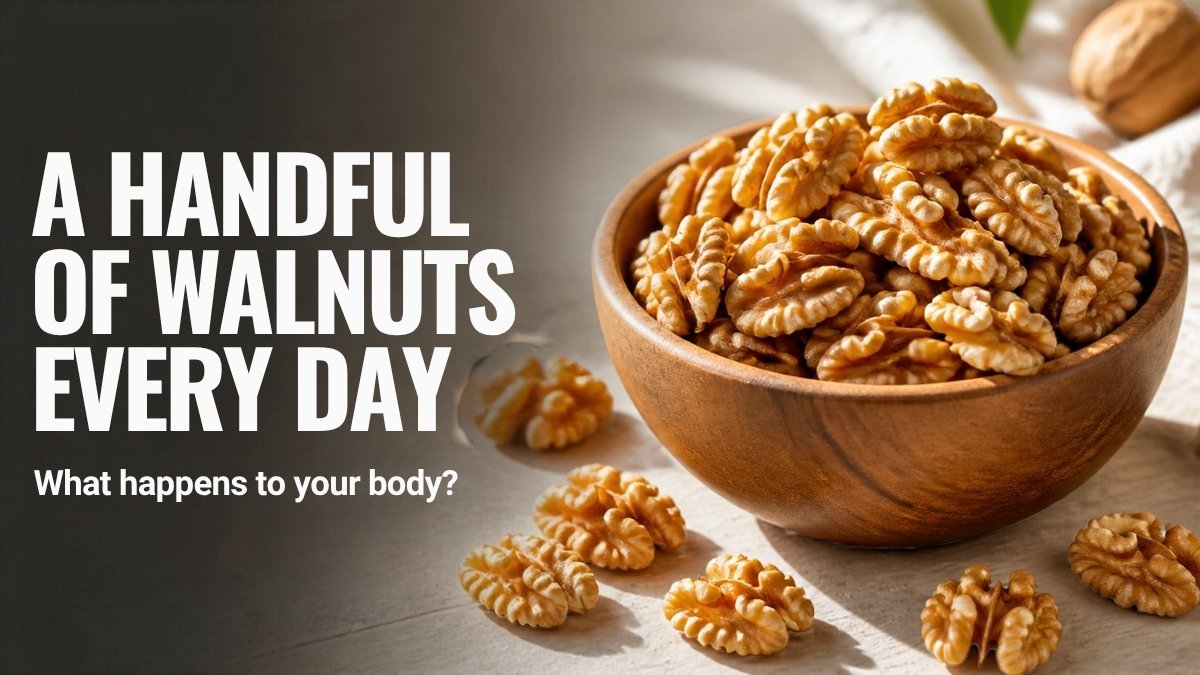
Eating a small handful of walnuts every day is one of the simplest food habits you can build, and for most people it’s a healthy one. Over time, a daily serving may help improve your cholesterol, support your heart and blood vessels, feed the good bacteria in your gut and keep you fuller between meals. The catch is portion size: walnuts are calorie-dense, so about 1 ounce (roughly 14 halves) a day is the sweet spot.
What’s in a Handful of Walnuts?
A “handful” is usually defined as about 1 ounce (28 grams), or roughly 14 walnut halves. Here’s an approximate look at what that serving provides, compared with the same amount of almonds. Values vary slightly by variety and source.
| Per 1 oz (~28 g) | Walnuts | Almonds |
|---|---|---|
| Calories | About 185 | About 165 |
| Protein | About 4 g | About 6 g |
| Total fat | About 18 g | About 14 g |
| Saturated fat | About 1.7 g | About 1 g |
| Polyunsaturated fat | About 13 g | About 3.5 g |
| Plant omega-3 (ALA) | About 2.5 g | Almost none |
| Carbohydrates | About 4 g | About 6 g |
| Fiber | About 2 g | About 3.5 g |
| Sugar | Under 1 g | About 1 g |
| Magnesium | About 45 mg | About 75 mg |
| Copper | About 0.45 mg (about half the daily value) | About 0.3 mg |
The standout number is the omega-3. Walnuts are the only common tree nut with a meaningful amount of alpha-linolenic acid (ALA), the plant form of omega-3 fat. One ounce covers more than the daily adequate intake for most adults.
1. Your Cholesterol May Improve
Walnuts are among the most researched nuts for heart health. Controlled studies have found that adding walnuts to the diet, especially in place of foods high in saturated fat or refined carbs, may help modestly lower total and LDL (“bad”) cholesterol. The effect isn’t dramatic, but it’s consistent, and it adds up alongside other healthy habits.
A few reasons walnuts may help:
- Unsaturated fats. Most of the fat in walnuts is polyunsaturated, which is generally linked with healthier cholesterol levels.
- Plant sterols. These natural compounds have a structure similar to cholesterol and may reduce how much cholesterol your gut absorbs.
- Fiber. Walnuts add a little fiber, which also plays a role in cholesterol balance.
2. Your Heart and Blood Vessels May Benefit
Beyond cholesterol, walnuts contain ALA omega-3, polyphenol antioxidants and the amino acid arginine, which your body uses to make nitric oxide, a molecule that helps blood vessels relax. Some studies suggest regular walnut eaters may have better blood vessel function and, in some cases, slightly lower blood pressure.
Large population studies have also linked eating nuts several times a week with a lower risk of heart disease. That kind of research can’t prove that nuts alone are responsible, but the overall pattern is encouraging, and it’s one reason the American Heart Association lists nuts as part of a heart-healthy eating pattern.
3. Your Gut Bacteria May Get a Boost
Your gut microbiome feeds on what you eat, and walnuts appear to be a good meal for it. Research has found that eating walnuts daily may increase certain beneficial bacteria, including types that produce butyrate, a short-chain fatty acid that helps nourish the cells lining your colon.
Walnuts are also rich in polyphenols called ellagitannins. Gut bacteria convert these into compounds that are being studied for possible anti-inflammatory effects. This area of research is still young, but it’s another reason walnuts are more than just “healthy fat.”
4. You May Feel Fuller Between Meals
It might seem odd that a high-calorie food could help with weight control, but nuts tend to be very satisfying thanks to their mix of fat, protein and fiber. Studies generally haven’t found that people gain weight when they add a moderate portion of nuts to their diet, partly because they naturally eat a bit less of other foods.
Your body also may not absorb every calorie listed on the label, since some of the fat stays trapped in the nut’s cell walls. Still, walnuts work best as a swap, not an add-on. Trade them for chips, cookies or a sugary granola bar rather than eating them on top of those snacks.
5. Your Brain May Benefit Over Time
It’s hard to miss that a walnut looks a bit like a tiny brain, and researchers have been curious about the link. Walnuts provide omega-3 fat, polyphenols and vitamin E (mostly in a form called gamma-tocopherol), all of which are being studied for brain health. Some observational research has associated eating nuts with better memory and thinking in older adults.
The evidence here is less certain than it is for heart health, so think of this as a possible bonus rather than a promise.
Possible Downsides to Keep in Mind
Walnuts are a healthy food for most people, but there are a few things to watch:
- Tree nut allergy. Walnuts are a common allergen. If you’re allergic to tree nuts, avoid them and talk to your allergist.
- Calories add up fast. Eating straight from a big bag can easily turn one serving into three or four. Pre-portion them into small containers.
- Candied and honey-glazed versions. These can carry a lot of added sugar. Plain raw or dry-roasted walnuts are the better pick.
- Digestive comfort. If you’re not used to eating nuts, start with a smaller amount to avoid bloating.
- Freshness. Because they’re high in polyunsaturated fat, walnuts can go rancid. Store them in an airtight container in the fridge or freezer.
Easy Ways to Eat Walnuts Every Day
- Sprinkle chopped walnuts over oatmeal or Greek yogurt with berries.
- Toss a handful into a green salad with apple slices.
- Pair them with a piece of fruit for an afternoon snack.
- Blend them into a smoothie for extra creaminess.
- Use crushed walnuts as a crunchy coating for fish or chicken instead of breadcrumbs.
The Bottom Line
A daily handful of walnuts is a small habit with potentially big payoffs. Thanks to their plant omega-3s, polyphenols and fiber, walnuts may help lower LDL cholesterol, support heart and blood vessel health, nourish your gut bacteria and keep you satisfied. Stick to about 1 ounce a day, choose plain unsweetened walnuts and use them to replace less healthy snacks rather than adding them on top.
This article is for general information only and is not medical advice. Talk to your doctor or a registered dietitian about what’s right for you.