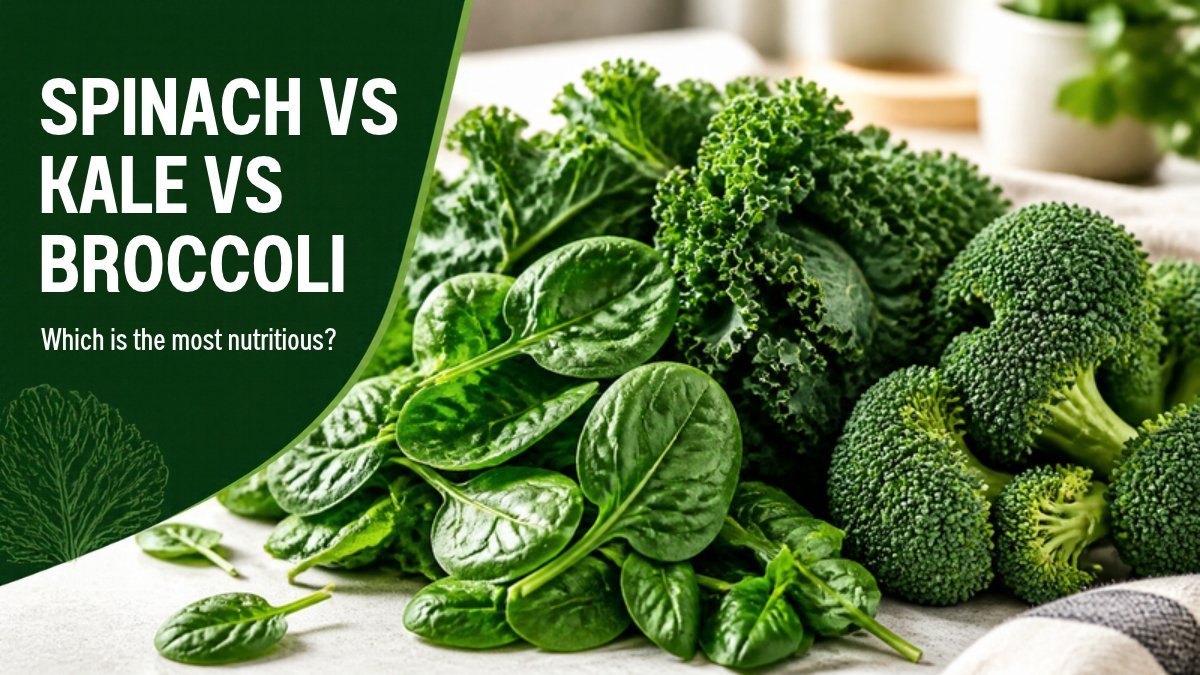
Spinach, kale and broccoli are all excellent choices, so there’s no wrong answer here. But they shine in different ways. Spinach leads for folate, iron, magnesium and potassium. Kale is the best of the three for absorbable calcium and packs plenty of vitamin C. Broccoli offers the most vitamin C per bite along with sulforaphane, a compound researchers are especially interested in. The most nutritious plan is to rotate all three.
Spinach, Kale and Broccoli: Nutrition Side by Side
To keep the comparison fair, the table below uses the same weight of each vegetable: 100 grams raw, which is roughly 3 cups of loose spinach leaves, about 1.5 cups of chopped kale or 1 cup of chopped broccoli. Values are approximate and vary by variety, growing conditions and source.
| Per 100 g raw | Spinach | Kale | Broccoli |
|---|---|---|---|
| Calories | About 23 | About 35 | About 34 |
| Protein | About 2.9 g | About 2.9 g | About 2.8 g |
| Fiber | About 2.2 g | About 4 g | About 2.6 g |
| Vitamin C | About 28 mg | About 93 mg | About 89 mg |
| Vitamin K | About 480 mcg | About 390 mcg | About 100 mcg |
| Vitamin A (RAE) | About 470 mcg | About 240 mcg | About 30 mcg |
| Folate | About 195 mcg | About 60 mcg | About 65 mcg |
| Calcium | About 100 mg (poorly absorbed) | About 250 mg | About 47 mg |
| Iron | About 2.7 mg | About 1.6 mg | About 0.7 mg |
| Magnesium | About 80 mg | About 33 mg | About 21 mg |
| Potassium | About 560 mg | About 350 mg | About 315 mg |
Keep in mind that 100 grams of raw spinach is a big pile of leaves, while 100 grams of broccoli fits easily on a plate. Per typical serving, the numbers shift, but the overall strengths of each vegetable stay the same.
Why Spinach Stands Out
Spinach is one of the most nutrient-dense foods you can eat for very few calories. It’s especially rich in:
- Folate. This B vitamin helps your body make new cells and is especially important before and during pregnancy.
- Vitamins A and K. Spinach is loaded with beta-carotene, which your body turns into vitamin A, and it’s one of the richest sources of vitamin K, which supports normal blood clotting and bone health.
- Lutein and zeaxanthin. These plant pigments collect in the retina and may help protect your eyes as you age.
- Nitrates, potassium and magnesium. Leafy greens like spinach provide natural nitrates and potassium, both of which may help support healthy blood pressure.
The catch is oxalate. Spinach is high in this natural compound, which binds to calcium and iron and makes them harder to absorb. So while spinach looks impressive for calcium on paper, your body actually gets relatively little of it. Pairing spinach with a source of vitamin C, like lemon juice, strawberries or bell peppers, may help you absorb more of its plant-based iron.
Why Kale Stands Out
Kale earned its superfood reputation for good reason. Compared with spinach, it has much more vitamin C and fiber, and its calcium is low in oxalate, which means your body can absorb it well. That makes kale a useful calcium source for people who eat little or no dairy.
Kale also belongs to the cruciferous family, the same group as broccoli, cabbage and Brussels sprouts. These vegetables contain sulfur compounds called glucosinolates, which break down into substances being studied for their possible role in protecting cells. Kale is tougher than spinach, so massaging raw leaves with a little olive oil and lemon makes them more tender and pleasant in salads.
Why Broccoli Stands Out
Broccoli may look less exciting next to dark leafy greens, but it holds its own. Ounce for ounce, it’s an excellent source of vitamin C, and a single cup of chopped broccoli provides close to a full day’s worth for most adults.
Broccoli is best known for sulforaphane, a compound that forms when you chop or chew it. Lab and early human research suggests sulforaphane may help support the body’s natural detox and antioxidant defenses, though scientists are still learning how much this matters in everyday diets. Broccoli also provides fiber that feeds your gut bacteria, and it’s filling and easy to cook in dozens of ways.
A simple tip: chop broccoli and let it sit for a few minutes before cooking. This may give the enzyme that creates sulforaphane time to work.
Raw or Cooked: Does It Matter?
How you prepare these vegetables can change what you get from them:
- Cooking spinach shrinks it dramatically, so you eat far more in one serving. Cooking may also lower its oxalate content a bit, especially if you boil it and drain the water.
- Steaming broccoli for a few minutes is a good middle ground. Boiling for a long time can leach out vitamin C and other water-soluble nutrients.
- Adding a little healthy fat, such as olive oil, avocado or nuts, may help your body absorb fat-soluble nutrients like vitamins A and K, lutein and beta-carotene.
- Raw kale and spinach keep more of their vitamin C, so a mix of raw salads and cooked sides gives you the best of both.
Who Should Be Careful
These vegetables are safe and healthy for most people, but a few situations call for extra attention:
- Blood thinners. If you take warfarin, sudden changes in how much vitamin K you eat can affect how the medication works. You don’t necessarily need to avoid leafy greens, but try to keep your intake steady and talk to your doctor.
- Kidney stones. People prone to calcium oxalate stones are often advised to limit high-oxalate foods like spinach. Kale and broccoli are much lower in oxalate.
- Thyroid concerns. Very large amounts of raw cruciferous vegetables have been discussed in relation to thyroid function, but normal food portions are generally considered fine. Cooking reduces this concern further.
- Gas and bloating. Kale and broccoli can cause gas for some people. Increasing portions slowly and cooking them may help.
So, Which One Is the Most Nutritious?
If you had to choose just one, each has a case:
- Choose spinach for folate, vitamin A, magnesium, potassium and eye-friendly lutein.
- Choose kale for well-absorbed calcium, extra fiber and a big dose of vitamin C.
- Choose broccoli for vitamin C, sulforaphane and an easy, filling side dish.
In reality, you don’t have to choose. Mixing them across the week gives you a wider range of vitamins, minerals and plant compounds than eating any single one. Try spinach in a morning smoothie or omelet, kale in a lunchtime salad and roasted broccoli with dinner.
The Bottom Line
Spinach, kale and broccoli are all low in calories and rich in nutrients that may help support your heart, bones, eyes and gut. Spinach wins for folate, iron and potassium, kale for absorbable calcium and fiber, and broccoli for vitamin C and sulforaphane. The healthiest move is to eat a variety of them, prepared in ways you actually enjoy.
This article is for general information only and is not medical advice. Talk to your doctor or a registered dietitian about what’s right for you.