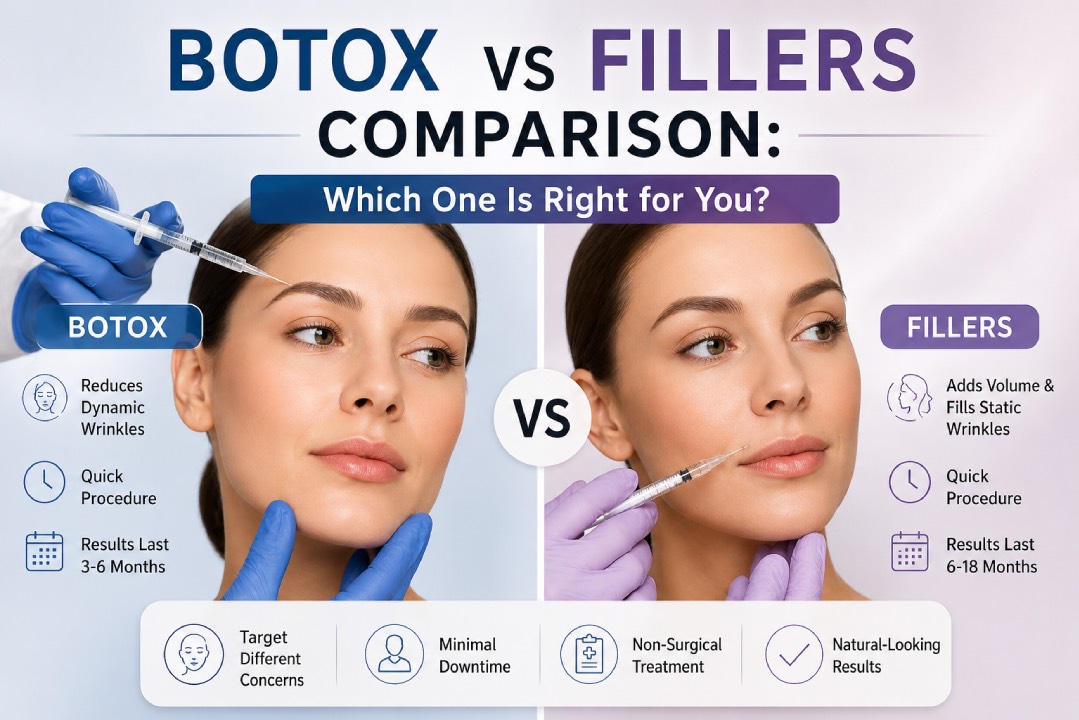
If you’ve been considering cosmetic treatments to refresh your appearance, you’ve probably come across two of the most popular options out there — Botox and fillers. Both are minimally invasive, both are done in a clinic, and both can take years off your face. But they work in completely different ways and are suited for different concerns.
This Botox vs fillers comparison will walk you through exactly how each treatment works, what it’s best for, how long it lasts, what it costs, and who should consider which option — so you can make a confident, informed decision.
What Is Botox?
Botox is a purified form of botulinum toxin. When injected in tiny amounts into specific facial muscles, it temporarily relaxes them. This reduces the appearance of lines and wrinkles caused by repeated muscle movement — like squinting, frowning, or raising your eyebrows.
Botox doesn’t add volume or fill anything. It simply pauses the muscle activity that creates those lines in the first place.
What Botox Is Best For
Botox works best on dynamic wrinkles — wrinkles that appear when your face is moving. Common treatment areas include:
- Forehead lines
- Frown lines (between the eyebrows)
- Crow’s feet (around the eyes)
- Bunny lines (on the nose)
- Lip lines
It’s also used medically for migraines, excessive sweating, and jaw clenching (bruxism).
How Long Does Botox Last?
Results typically appear within 3–7 days and last 3 to 6 months. With regular treatments over time, some people find they need touch-ups less frequently as the muscles gradually weaken.
Possible Side Effects of Botox
- Mild bruising or redness at the injection site
- Temporary headache
- Slight drooping of the eyelid or brow if injected incorrectly
- Results that look “frozen” if overdone
Side effects are usually minor and short-lived. Choosing a qualified, experienced injector significantly reduces risk.
What Are Dermal Fillers?
Dermal fillers are gel-like substances injected beneath the skin to restore volume, smooth out deep lines, and enhance facial contours. Most fillers are made from hyaluronic acid — a substance naturally found in the body — though other types exist, such as calcium hydroxylapatite or poly-L-lactic acid.
Unlike Botox, fillers don’t relax muscles. They physically fill in areas that have lost volume or developed deep creases.
What Fillers Are Best For
Fillers work best on static wrinkles and volume loss — lines and hollows that are visible even when your face is at rest. Common treatment areas include:
- Nasolabial folds (lines from nose to mouth)
- Marionette lines (corners of the mouth)
- Under-eye hollows (tear troughs)
- Cheeks and temples (volume restoration)
- Lips (adding fullness and definition)
- Jawline and chin (contouring)
How Long Do Fillers Last?
This depends on the type of filler and where it’s placed. Most hyaluronic acid fillers last 6 to 18 months. Some longer-lasting fillers can remain effective for up to 2 years. Fillers in high-movement areas (like lips) tend to break down faster.
One major advantage of hyaluronic acid fillers: they can be dissolved with an enzyme called hyaluronidase if you’re unhappy with the results.
Possible Side Effects of Fillers
- Swelling and bruising (very common, usually resolves in a few days)
- Lumps or unevenness if not placed correctly
- Rare but serious: vascular occlusion (blockage of a blood vessel) — this is why provider skill matters enormously
- Allergic reactions (uncommon)
Botox vs Fillers: Side-by-Side Comparison
| Topic | Botox | Dermal Fillers |
|---|---|---|
| How it works | Relaxes muscles | Adds volume and fills lines |
| Best for | Dynamic wrinkles | Static wrinkles and volume loss |
| Common areas | Forehead, crow’s feet, frown lines | Lips, cheeks, nasolabial folds |
| Results appear | 3–7 days | Immediately |
| Duration | 3–6 months | 6–18 months |
| Reversible? | No (wears off naturally) | Yes (hyaluronic acid fillers) |
| Average cost | Lower per session | Higher per session |
| Downtime | Minimal | Minimal to mild |
Can You Get Botox and Fillers Together?
Yes — and many people do. In fact, combining both treatments is sometimes called a “liquid facelift.” Botox handles the upper face (forehead, around the eyes), while fillers restore volume and smooth deeper lines in the mid and lower face.
When used together strategically by a skilled practitioner, the results can look very natural and refreshed. This combination approach is increasingly popular because it addresses both muscle movement and volume loss — the two main causes of facial aging.
Which One Is Right for You?
Here’s a simple way to think about it:
Choose Botox if:
- Your main concern is expression lines that appear when you move your face
- You want to prevent wrinkles from deepening over time
- You’re new to cosmetic treatments and want to start with something subtle
Choose Fillers if:
- You’ve noticed hollowness in your cheeks, under your eyes, or around your mouth
- You have deep lines that are visible even when your face is relaxed
- You want fuller lips or more defined facial contours
Consider both if:
- You want a more comprehensive facial rejuvenation
- You have concerns in both the upper and lower face
The best way to decide is to book a consultation with a qualified aesthetic practitioner. They can assess your face, understand your goals, and recommend the right combination for your specific needs.
How Much Do Botox and Fillers Cost?
Costs vary depending on your location, the provider’s experience, and how much product is used. As a general guide:
- Botox is usually priced per unit or per area. A single area (like the forehead) might cost $200–$500. Full face treatment is typically $400–$900.
- Fillers are usually priced per syringe. One syringe can cost anywhere from $500–$1,000, and some areas require more than one.
Always be cautious of very low prices — with injectables, the skill and experience of your provider is directly tied to your safety and results.
Frequently Asked Questions
Is Botox or fillers more painful?
Both involve injections, so some discomfort is expected. Most people find Botox injections quick and relatively painless — like a tiny pinch. Fillers can be slightly more uncomfortable depending on the area, though most contain a local anaesthetic (lidocaine) to reduce pain. Lips tend to be the most sensitive area.
Which lasts longer — Botox or fillers?
Fillers generally last longer. Most fillers stay effective for 6–18 months, while Botox typically lasts 3–6 months. However, this varies by product type and individual metabolism.
Are Botox and fillers safe?
Yes, when performed by a qualified and experienced professional. Both treatments have strong safety records. The most important factor in safety and results is choosing the right provider — not the cheapest one.
Can fillers look natural?
Absolutely. Overfilled results are usually the outcome of too much product or poor placement, not fillers themselves. A skilled injector uses conservative amounts and enhances your natural features rather than changing them dramatically.
At what age should you start Botox or fillers?
There’s no set age. Some people start Botox in their late 20s as a preventative measure. Fillers are more commonly considered in the 30s and 40s when volume loss becomes noticeable. The right time depends on your individual concerns, not a number.
Conclusion
When it comes to the Botox vs fillers comparison, neither treatment is universally better than the other — they simply do different things. Botox relaxes muscles to smooth expression lines, while fillers restore volume and fill in deeper creases. Many people benefit from using both together for a balanced, natural-looking result.
Whatever you decide, the most important step is consulting with a qualified professional who can guide you based on your face, your goals, and your budget. Done well, both Botox and fillers can help you look refreshed, natural, and confidently yourself.
This article is for informational purposes only and does not constitute medical advice. Always consult a qualified medical professional before undergoing any cosmetic procedure.